
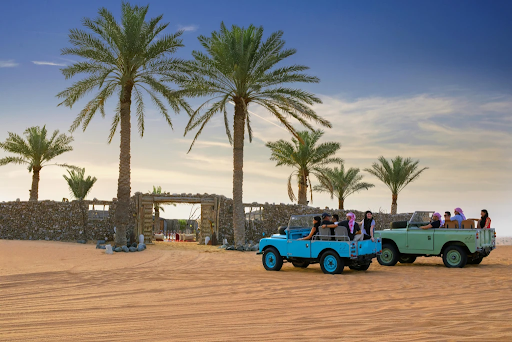
Structured safari travel has shifted from spontaneous adventure toward carefully engineered exploration. Modern travelers now expect clarity, safety, learning, and control without losing the essence of discovery that defines a true safari.
This evolution is where the Land Rover Safari Tour establishes a distinct identity. Instead of relying on loosely planned routes or unpredictable pacing, it introduces a deliberate framework where terrain analysis, vehicle capability, expert guidance, and timing work in unison. The experience feels intentional rather than restrictive, thereby allowing participants to focus on observing landscapes, understanding environments, and absorbing context instead of managing uncertainty.
This structured approach transforms a safari into a refined exploration model, appealing to travelers who value preparation, informed movement, and meaningful engagement. It reflects a broader shift in adventure travel, one that prioritizes depth, reliability, and insight while still preserving the thrill of exploring remote and challenging landscapes.
Precision-Led Route Design as the Foundation
At the core of a structured safari lies deliberate route design informed by terrain science and environmental responsibility.
- Terrain-specific planning: Routes are selected based on soil composition, elevation changes, and environmental sensitivity. Each path is assessed for vehicle compatibility and ecological impact, ensuring exploration remains controlled while still immersive. This eliminates unnecessary detours and reduces environmental strain.
- Progressive difficulty sequencing: The journey unfolds gradually, beginning with manageable terrain before advancing into more complex sections. This structure builds confidence and understanding, allowing travelers to adapt comfortably rather than being overwhelmed early in the experience.
- Predictable pacing without rigidity: Time allocation is balanced between driving, observation, and explanation. Participants are never rushed, yet the itinerary remains disciplined. This rhythm keeps the experience engaging while maintaining logistical efficiency throughout the safari.
Together, these elements ensure that exploration remains immersive while operating within a controlled and sustainable framework.
Vehicle Engineering as an Active Experience Partner
In a structured safari, the vehicle is not just transportation; it is a functional partner in exploration.
- Capability aligned with landscape behavior: Vehicles respond dynamically to sand, rock, and uneven surfaces. Advanced traction and suspension systems work quietly in the background, allowing travelers to focus on the surroundings rather than the mechanics of movement.
- Comfort that supports long exploration windows: Seating, visibility, and cabin ergonomics are designed for extended travel. This comfort reduces fatigue, making it possible to absorb details of the environment over longer durations without distraction.
- Technology that enhances awareness: Driver-assist systems and terrain response features are explained during the journey, helping participants understand how engineering adapts to nature. The vehicle becomes an educational tool, not just a mode of transport.
This integration of engineering and environment allows travelers to experience landscapes with confidence and clarity.
Knowledge-Driven Guidance Over Passive Touring
Guidance in a structured safari prioritizes understanding over observation, turning movement into an ongoing learning process.
- Contextual interpretation of landscapes: Guides connect visible terrain features with ecological and geological processes. Explanations link land formations, vegetation, and water presence to environmental behavior. This context turns passive viewing into informed exploration at every stage of the journey.
- Decision-making transparency: Operational choices such as route selection and pace adjustments are clearly communicated. Travelers understand why decisions are made based on conditions rather than assumptions. This clarity builds trust and strengthens confidence in the safari structure.
- Learning is integrated into movement: Insights are shared continuously while the journey progresses between locations. This approach avoids interrupting the flow of travel for isolated briefings. Learning becomes a natural part of movement rather than a separate activity.
As a result, travelers engage more deeply with the terrain rather than simply passing through it.
Risk Management Without Diluting Adventure
Effective risk management ensures that challenging environments are approached with preparation rather than hesitation.
- Controlled exposure to challenging terrain: Challenging segments are introduced with careful planning and clear guidance. Participants are informed about terrain conditions and required precautions before entry. This structured approach preserves excitement while maintaining consistent safety standards.
- Preparedness through standardization: Operational protocols such as equipment inspections and vehicle coordination are applied uniformly. These systems function seamlessly without disrupting the experience. As a result, safety remains assured without drawing attention away from exploration.
- Confidence built through consistency: Consistent procedures create a predictable and reassuring environment for travelers. This reliability reduces uncertainty, even in isolated landscapes. With confidence established, participants engage more fully with their surroundings.
This balance allows adventure to remain authentic while safeguarding both participants and landscapes.
Structured Freedom as the Defining Experience
True structure does not eliminate freedom; it refines how freedom is experienced within clear boundaries.
- Choice within a defined framework: Planned routes provide operational clarity while allowing space for spontaneous moments of exploration. Travelers can pause for photography, observation, or discussion without affecting the flow of the journey. This flexibility ensures personal engagement exists within a well-managed safari structure.
- Focus on quality over quantity: The experience emphasizes depth rather than distance by selecting landscapes with distinct value. Each stop is chosen for its learning, visual, or environmental significance. This approach avoids rushed movement and encourages meaningful interaction with every location visited.
- A model that reshapes expectations: The Land Rover Safari Tour shows that structure enhances, rather than restricts, adventure. Travelers gain practical insight into terrain behavior, vehicle capability, and responsible exploration. This clarity redefines the safari as an informed and purpose-driven experience.
This approach reshapes expectations by proving that thoughtful structure can elevate exploration.
Final Thoughts
Structured safari experiences are no longer about rigid itineraries or passive observation. They are about intentional design, informed movement, and respectful interaction with nature.
By aligning route planning, vehicle capability, expert guidance, and risk management, this model delivers clarity without sacrificing wonder. Travelers gain confidence, insight, and a deeper connection to landscapes, proving that structure, when applied thoughtfully, enhances exploration rather than limiting it.
This philosophy is further reflected in the Land Rover Heritage Safari Tour, where legacy, learning, and landscape awareness come together seamlessly.
For those seeking a disciplined yet engaging way to explore remote landscapes, thoughtfully curated options available at Touristify provide a reliable starting point. Discover how structured exploration can elevate travel by choosing experiences designed with precision and purpose by Touristify.


